Industry II: One Lens, One Aperture, One Format
A new series, shot entirely inside a set of rules I fixed before I left the house and did not allow myself to break.
Industry II is about limitation. Not as a concept bolted on afterwards, but as the actual working method. Every frame was made under the same constraints, and the constraints are the reason the pictures look the way they do.

CR-03, Industry II.
Gas holders and walkways, vertical pipes cutting into an open sky.
The rules
Panasonic S5 II X, one 85mm lens on full frame, and nothing else in the bag. Aperture fixed at f/5.6 for every frame in the series. Fully manual exposure. Manual focus throughout. The camera screen set to monochrome. The crop set to 1:1 in camera.
Two of those changed more than the rest.
The monochrome screen. If you cannot see colour, you stop composing for it. What is left is what black and white photography actually runs on, which is tonal separation and shape. A scene that looks dull in colour and superb in grey is a scene you would walk past with a normal screen.
The square crop in camera. The frame is decided at the shutter, not at the desk. Every picture in this series was composed in the format it will be printed in, which means nothing was rescued by a later crop and nothing needed to be.

Manual exposure means the shutter is a compositional decision.
The blades resolve into rings.
Why work this way
A modern camera will make almost every decision for you, and it will make them competently. That is exactly the problem.
Fixing the aperture removes a variable I would otherwise spend attention on. Manual focus slows the hand, which slows the eye, and slowing the eye is the entire mechanism. The camera stops being a device that reacts and becomes a device you operate.
What I wanted was a film camera without the film. Not out of nostalgia. Because the limits film imposed produced a way of looking that I miss, and it turns out you can rebuild most of those limits on a digital body if you are willing to switch things off.
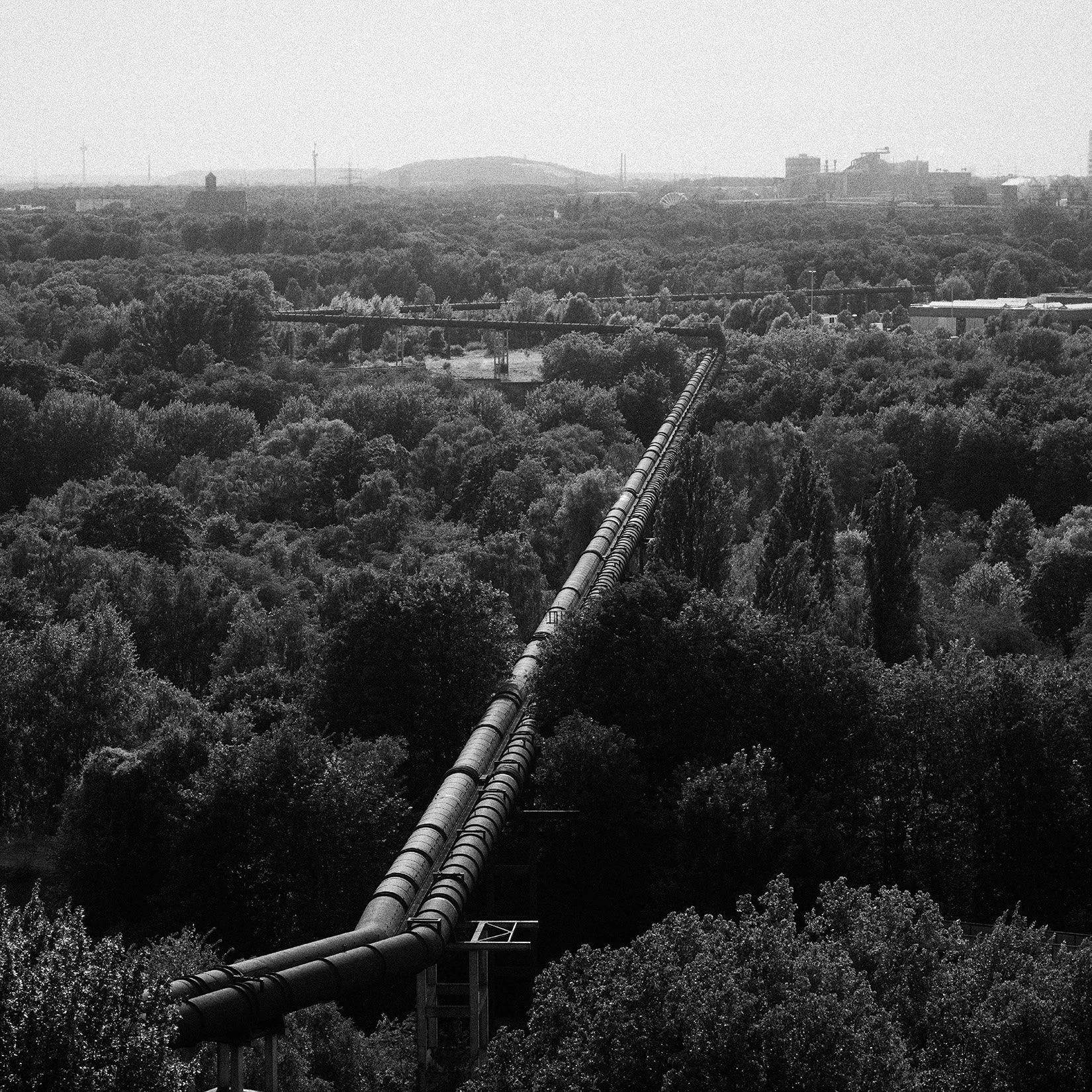
A pipeline running out through the trees.
The square frame refuses the panorama the scene keeps asking for.

f/5.6 across the series.
Enough depth to hold the layers, not enough to flatten them.
The look
Deep blacks and a film-like grain structure, as with everything under the Cruentis name. That part is not a constraint. It is the house style, and it is the reason the series is printed on the paper it is printed on.
The prints
Every work in Industry II is produced identically. Hahnemühle FineArt Baryta at 325 gsm, a textured paper with a soft natural gloss that holds deep blacks and fine detail. Made to order by a certified fine art lab in Germany. Square, 60 x 60 cm, with a 5 cm white border that is part of the finished work.
Each image is limited to seven prints worldwide, released in three phases. Phase I is 420 euro for three prints, Phase II 525 euro for two, Phase III 650 euro for two. When a phase sells out, the next opens at a higher price. Every print is tracked individually and arrives with a certificate showing its edition number and phase.
Prints ship unframed and unmounted, so the framing decision stays yours.

Capturing a Pigeon midflight with manual focus.
A lot of patience was needed here.
I NDUSTRY II AT A GLANCE
Camera: Panasonic Lumix S5 II X
Lens: 85mm
Aperture: f/5.6, fixed across the series
Focus: Manual
Shutter: Manual
Monitoring: Camera screen set to monochrome
Format: 1:1, set in camera before the shutter
Paper: Hahnemühle FineArt Baryta, 325 gsm
Print size: 60 x 60 cm, 5 cm white border
Edition: 7 prints per image, three phases
Production: Made to order, certified fine art lab in Germany
Frequently asked questions
Why set the camera screen to monochrome?
Because you compose for what you can see. With colour on the screen you judge a scene on colour relationships that will not exist in the final print. In monochrome you judge it on tonal separation and shape, which is what a black and white photograph is actually built from. Scenes that look unremarkable in colour and strong in grey are the ones you would otherwise walk past.
Why set a square crop in camera instead of cropping afterwards?
Cropping later turns composition into a repair job. Setting 1:1 in camera means the frame is decided at the moment of the exposure, with the subject in front of you, and everything in the frame has to earn its place while you can still move. It also means the printed work is exactly what was seen through the camera.
What is FineArt Baryta paper?
A heavy fine art inkjet paper with a barium sulphate coating, the same principle used in traditional darkroom baryta papers. It has a textured surface with a soft natural gloss and produces denser blacks and finer detail than matte papers. For high-contrast black and white work it is the closest an inkjet print gets to a darkroom print.
How does phase pricing work?
Each image exists in seven prints, split across three phases. The first three sell at 420 euro, the next two at 525 euro, the final two at 650 euro. Each phase opens only when the one before it has sold out, so early collectors pay less and later prints reflect the reduced availability. The certificate records which phase a print came from.